Choosing a Kitchen Worktop: Timber, Stone and Other Surfaces
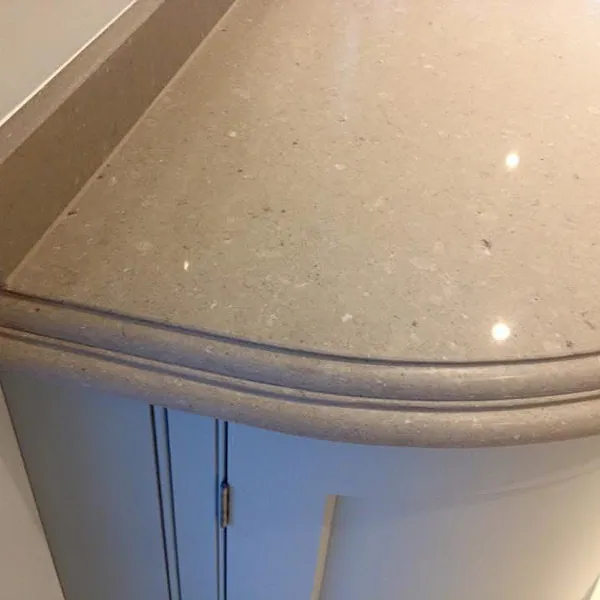
The worktop is the part of the kitchen you live with most closely. It is where the chopping happens, where the kettle sits, and where a splash of water is wiped away at the end of the evening. It also has to sit happily with the cabinets underneath. At R.E. Woods & Son we make the cabinetry in our family workshop, and we like to settle the worktop while the kitchen is being drawn, so the two are designed as one piece of furniture.
Stone is usually cut and fitted by a mason, and we work closely with trusted local stone masons so the joints, the sink and the support all agree. The timber, carcass and hardware in the cabinets themselves are in our guide to choosing materials, with the wider question of cost in the cost guide.
Timber worktops
A solid timber top, most often oak, is warm under the hand. Light knife marks and a pale ring can usually be sanded and oiled again. Walnut brings a richer colour beside painted doors. An oil or a hardwax oil keeps the grain fed. Leave it too long and the surface dries, and a hot pan prints itself more clearly. Water around the sink needs the most care. An undermount bowl in timber is perfectly possible when the cut-out edge is thoroughly sealed, so water cannot sit there and find its way into the wood. A sink that drops in from above, or a butler sink in front of the run, is another lovely route, and we will detail the top around whichever you prefer.
Stone
Stone is cool, heavy and patient with heat. We build carcasses in solid timber or high-density melamine-faced MDF so a slab has a steady home, and a mason usually templates the room once the cabinets are fitted, so the joints and the sink fall where the drawing intended.
Marble asks for a little care, because lemon, wine and some cleaning sprays will etch a polish. A honed finish is quieter and kinder, though a board under the citrus is still wise. Granite is harder and more forgiving of heat and acid. Quartz, bound with resin, gives an even pattern and shrugs off etching, while a very hot pan can still mark it, so a trivet earns its place. Porcelain and sintered ceramic tops are thin and very hard, excellent with heat and stains, and a knocked corner can chip.
Our Burnham Market kitchen pairs green paint and brass with a pale worktop, and the wider gallery shows more of these calm pairings.
Laminate, steel and solid surface
Laminate is practical and easy to wipe, especially in a compact grade rather than a thin post-formed strip. Stains bother it less than a burn does, and a joint that stays wet can swell, so a drop-in sink is the natural partner. Stainless steel loves a busy hob, takes the heat, and shows fingerprints honestly. Solid-surface boards sit between timber and stone: they join with a quiet seam, can be sanded if scratched, and can turn up into an upstand behind the sink. A trivet is still a friend to them.
Pairing the top with the cabinets
Painted doors with a timber top keep a room warm. Painted doors with a pale stone feel fresh. Oak with stone gives you grain in the furniture and a harder surface to work on, and oak with an oak top reads as one material. Look at samples together in the morning and the evening, because a cool grey top can cool a warm paint. Our notes on painted finishes go further into that.
Thickness matters too. A stone slab and a timber board are different depths, and that changes door heights, the oven housing and the gap under a window, so we like to know the kind of top while the cabinets are drawn. The final measure, in millimetres, is described in the planning guide. Beside a range or an Aga the top has a harder life, which is why we also wrote about designing around a range cooker or an Aga.
Questions we are often asked
Do you make stone worktops in the workshop?
Stone is cut and fitted by a mason. We design the cabinets so the top has a solid, level home, and we work with trusted local stone masons so the joints and the sink opening follow the same drawing.
Can a timber worktop be repaired if it marks?
Light knife marks and dried water rings can usually be sanded, and the surface oiled again. A deep burn, or timber that has stayed wet beside the sink, needs a little more attention. Being able to renew the surface is one of the pleasures of a timber top.
When should we choose the worktop?
The exact slab can wait until you have seen samples in the room. The type of top, whether timber, stone or a thinner board, is best known while the cabinets are being drawn, because the thickness, the weight and the sink all shape the furniture.
Come and talk it through
If you are weighing up a worktop, bring the question with the rest of the kitchen. We would be glad to look at samples with you. Call us on 01362 850460 or get in touch.